Payment Terms for Home and Garden Wholesalers on Shopify
How home goods wholesale payment terms work on Shopify Plus: deposit tiers by order value, due on fulfillment for freight orders, and spring dating.
Key Takeaways
- 1Home and garden wholesale ships by freight, so a Net 30 clock that starts at checkout can run out before the goods arrive.
- 2Due on fulfillment fits bulky orders: the balance comes due when the order ships, not a set number of days after checkout.
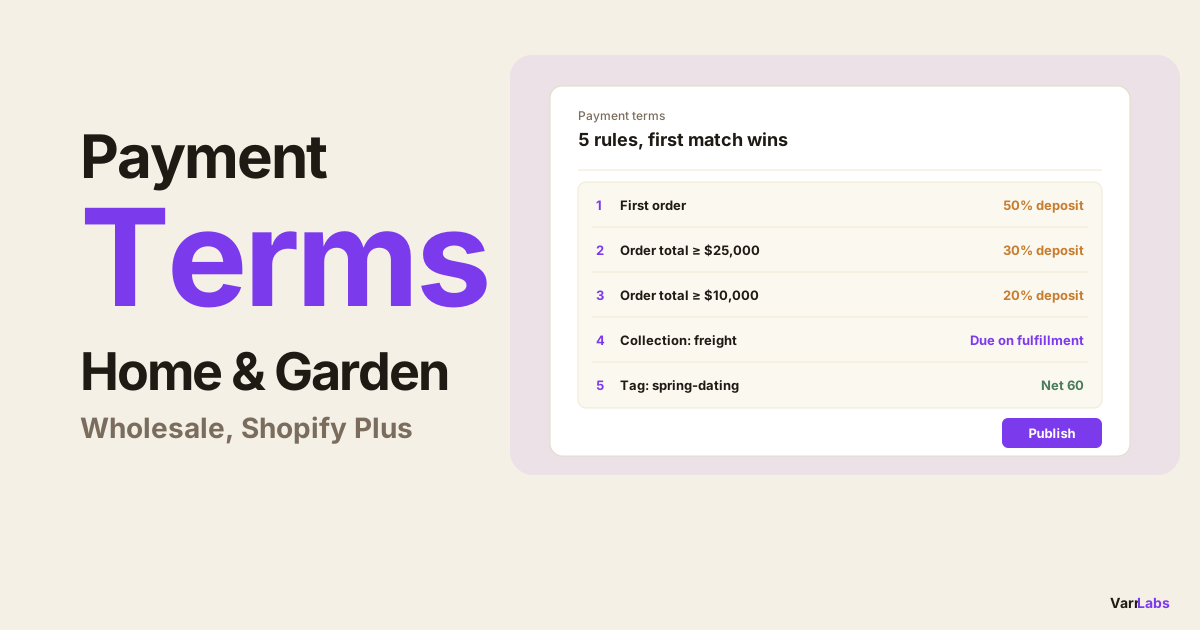
- 3A starting recipe: 50% deposit on first orders, 30% at $25,000 and up, 20% at $10,000 and up, and Net 60 for tagged spring accounts.
- 4Shopify stores one static term and one deposit percentage per company location, so it can't tell a pallet order from a floor set.
- 5TermStack applies deposit tiers and freight terms per order at Shopify's native B2B checkout, with a simulator to test rules first.
Home goods wholesale payment terms have a problem most other verticals don't: the product is big. A pallet of planters or a container of patio furniture can sit for weeks between the order and the truck, and a Net 30 clock that starts at checkout runs out before the retailer has unwrapped anything.
So the question for home and garden wholesalers on Shopify Plus isn't only how long to give a buyer. It's when the clock starts, and how much of a large order you want in the bank before you book the freight.
This post covers the term structures that fit home and garden wholesale, a five-rule recipe with real numbers, and what Shopify does natively versus what needs a rule at checkout.
What makes home and garden wholesale payment terms different
Most payment terms advice assumes small parcels that ship the day after the order. Home and garden breaks that assumption in four ways.
Bulky goods and freight timing. Furniture, planters, outdoor heaters, and bagged soil move by pallet, not by parcel. Freight gets booked, consolidated, and scheduled, so the gap between order and delivery is long and uneven. A date-based term bills the buyer for time the goods spent in your warehouse.
The spring reset. Garden centers and home stores reset their floors for spring. They place those orders ahead of the season, in volume, for stock that won't sell until the weather turns. Nobody wants to pay for a spring floor set in the dead of winter.
Large order values. A floor set of outdoor furniture is a big invoice. When one order is that large, a deposit stops being a sign of distrust and becomes the normal way to do business. In this vertical, deposits on large orders are standard.
A long tail with mixed credit. You sell to regional chains with a finance team, and you sell to a single-location garden center run by its owner. Their creditworthiness isn't the same, and you can't run a credit check on every small shop that wants to open an account.
Put those together and one static term per account can't hold. The right term depends on the order: how big it is, how it ships, and who's placing it.
The term structures that fit home goods wholesale
Four structures cover most of what home and garden wholesalers do.
| Structure | What it means | Where it fits |
|---|---|---|
| Deposit tiers by order value | A bigger deposit as the order gets bigger | Large floor sets and container orders |
| Due on fulfillment | The balance comes due when the order ships | Freight-heavy orders with a long gap before delivery |
| Spring dating | Net 60 on pre-season orders | Trusted accounts stocking up for the spring reset |
| Standard Net 30 | Full payment 30 days after the order | Established accounts, parcel-sized reorders |
Due on fulfillment is the one that fits this vertical best. It's an event-based term: the payment comes due when the order is fulfilled, not a fixed number of days after checkout. If the freight takes three weeks to arrange, the buyer isn't paying for those three weeks. The due on fulfillment explainer covers the three event-based terms Shopify supports and when each one fits.
Pair it with a deposit and you get the standard home and garden arrangement. The buyer commits money at checkout, and the balance waits for the truck.
The five-rule recipe, with numbers
Here's a starting recipe. Adjust the thresholds to your margins, but keep the order, because rules evaluate top down and the first match wins.
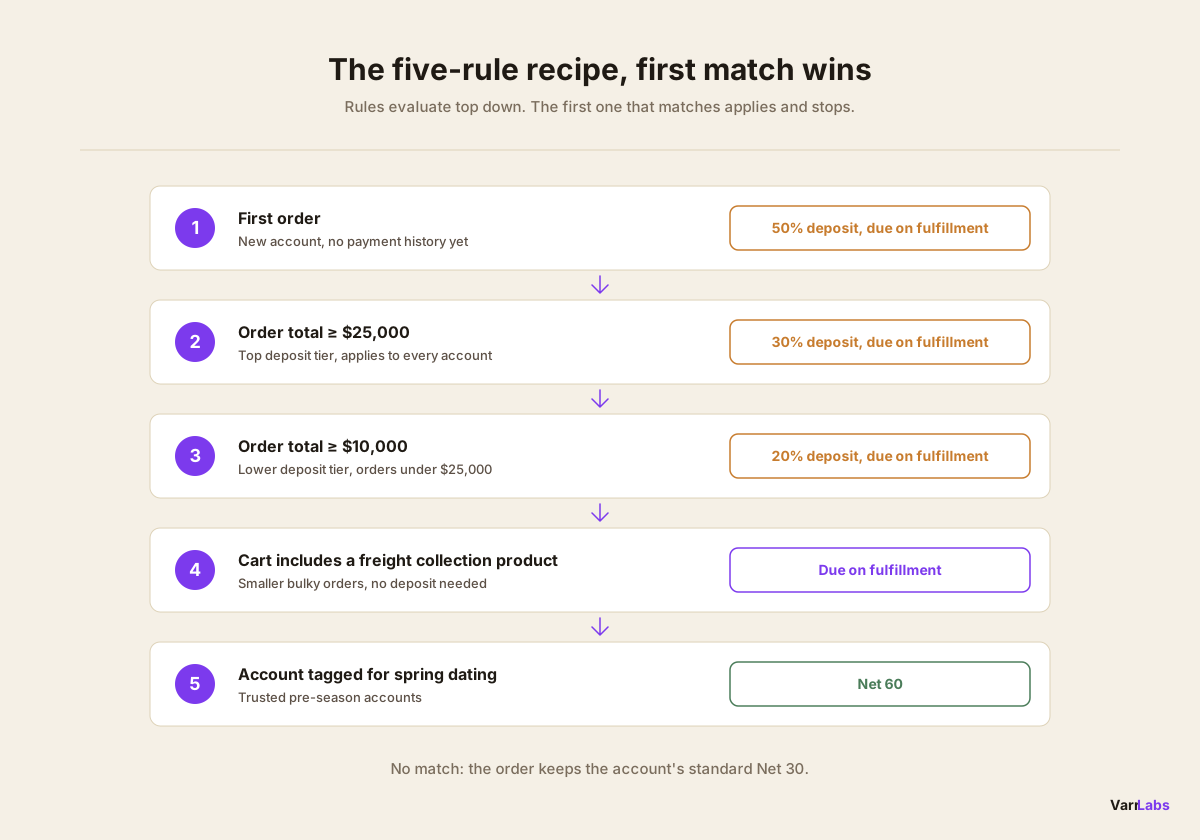
- First order, apply a 50% deposit with the balance due on fulfillment. This is your protection against the long tail. A shop you've never sold to puts half down before you book a truck. The first-time buyer prepayment post covers the reasoning.
- Order total is $25,000 or more, apply a 30% deposit with the balance due on fulfillment. The top deposit tier. It applies to every account, including your best ones, because the exposure on one large order is the same whoever places it.
- Order total is $10,000 or more, apply a 20% deposit with the balance due on fulfillment. The lower tier. It sits below rule two, so an order only lands here if it's under $25,000.
- Cart includes a product from your freight collection, apply due on fulfillment with no deposit. This catches the smaller bulky orders. A single pallet of planters doesn't need a deposit, but its clock still shouldn't start until it ships.
- Account is tagged for spring dating, apply Net 60. Your trusted pre-season accounts get extended terms on ordinary orders during the spring window.
Anything that matches none of the five keeps your standard Net 30.
Run a few orders through it. A new garden center placing an $8,000 first order hits rule one and pays $4,000 at checkout. An established chain placing a $32,000 patio furniture order hits rule two, pays $9,600 at checkout, and owes $22,400 when it ships. A $14,000 order hits rule three: $2,800 down, $11,200 on fulfillment. A $3,500 pallet of planters hits rule four and owes nothing until the truck leaves.
The deposit percentages line up with the usual wholesale norms. If you want the thinking behind the numbers, how much deposit to require on wholesale orders goes through it, and the payment terms by order value post covers where to set the thresholds.
Freight-heavy orders without a freight condition
Here's the limitation to design around. A rule at checkout can't see that an order ships by freight. There's no condition for weight, pallet count, or shipping method.
So you tell it which products are freight products. Put your bulky items in one collection: furniture, large planters, pallet quantities of soil and stone. The rule in step four is written against that collection, and any cart containing one of those products gets the event-based term.
It's easy to maintain, because the collection is a list you already keep in your head. When you add a new freight item, you add it to the collection and the rule covers it.
The spring window works the same way. A rule at checkout can't read the calendar, so you tag the accounts you want on dating, and you remove the tag when the window closes.
How you'd do this natively, and where it breaks
Shopify lets you assign a payment term per company location. Go to Customers → Companies → [Company] → Location, pick a template such as Net 30 or due on fulfillment, optionally set a deposit percentage, and save.
That's a static assignment. It applies to every order from that location until a person changes it. For home and garden wholesale it breaks in three places:
- Deposit tiers. The stored term doesn't know the order total. A $3,000 reorder and a $40,000 floor set get the same deposit percentage.
- Freight versus parcel. You can set due on fulfillment on a location, but then every order from that account is due on fulfillment, including the box of hand tools that ships tomorrow.
- Mixed credit. Nothing checks whether it's the buyer's first order. A new account gets whatever was set when the company was created.
The native versus app comparison walks through the full boundary.
Common mistakes to avoid
Putting the freight rule above the deposit tiers. First match wins. If the freight rule sits on top, a $40,000 furniture order matches it first and ships with no deposit.
Putting the larger tier below the smaller one. A $30,000 order is also over $10,000. The $25,000 rule has to come first or it never fires.
Leaving the spring tag on. If you never remove it, those accounts stay on Net 60 through the summer. Make removing the tag part of your post-season close.
Testing on a live order. These rules touch your largest orders. Run each scenario through a simulator first. The guide to testing payment rules before go-live walks through it.
When native Shopify isn't enough
Everything in the recipe depends on reading the order at checkout: its total, its products, the buyer's history. Native terms have no evaluation step, so there's nothing to attach a condition to.
TermStack checks order total, collections, first order, and tags, then applies the right deposit and term automatically. Try TermStack free for 14 days →
TermStack is the app I built for this. It runs your rules at Shopify's native B2B checkout through a Payment Customization Function, with no external call during checkout. Each rule combines conditions with an outcome, and an outcome is a payment term plus an optional percentage or fixed deposit. You test every scenario in the simulator before you publish, and you can roll back to a previous version if a rule turns out wrong.
Quick reference
| Rule (in order) | Condition | Applied term |
|---|---|---|
| 1 | First order | 50% deposit, balance due on fulfillment |
| 2 | Order total $25,000 or more | 30% deposit, balance due on fulfillment |
| 3 | Order total $10,000 or more | 20% deposit, balance due on fulfillment |
| 4 | Cart includes a freight collection product | Due on fulfillment |
| 5 | Account tagged for spring dating | Net 60 |
| No match | Standard Net 30 |
Frequently asked questions
Summary
Home and garden wholesale is a freight business, and the terms have to respect that. The goods are bulky, the orders are large, the spring reset pulls buying forward, and the account base runs from regional chains to single shops.
Five rules cover most of it: a 50% deposit on first orders, a 30% and a 20% deposit tier by order value, due on fulfillment for anything in your freight collection, and Net 60 for tagged spring accounts. Keep the deposit rules on top and the larger tier above the smaller one.
- Try the live demo store → to see deposit rules applying at a real B2B checkout.
- Want help setting up your first rules? I'll do it with you on a free 30-minute call: your deposit tiers, live at checkout, before the call ends. Email termstack@varrlabs.com.
TermStack gives you the conditions, the simulator, and the version history to run that policy at Shopify's native checkout, so every large order carries a deposit that matches its size and every freight order starts its clock when it ships.