How Much Deposit Should You Require on Wholesale Orders?
How much deposit to require on wholesale orders: 20-30% on large orders, 50% on first orders, 30-50% on custom, and how to enforce it on Shopify Plus.
Key Takeaways
- 1There's no single right deposit. Price it to the risk: bigger orders, new accounts, and custom goods each justify more upfront.
- 2Common norms: 20-30% on large stock orders, 50% on a new account's first order, and 30-50% on made-to-order or custom work.
- 3100% upfront isn't a deposit, it's prepayment. Right for brand-new accounts and one-off custom runs, overkill for a proven buyer.
- 4Shopify Plus only does one static deposit percentage per company location. Charging different deposits by order size, history, or product mix needs a rules engine.
- 5TermStack sets deposits as a conditional outcome at Shopify's native B2B checkout, keyed to order total, first order, order count, and cart contents, tested in a simulator before you publish.
If you sell wholesale on Shopify Plus, at some point a buyer places an order big enough that shipping it on open terms feels like a bet. So you ask for a deposit. The question is how much.
There's no single right number, and anyone who gives you one is guessing. The deposit that fits a $2,000 reorder from a buyer who's paid you ten times isn't the deposit that fits a $60,000 first order from a company you found last week.
This post covers how to size a wholesale deposit to the actual risk, the percentages most merchants land on by scenario, and how to charge different deposits on different orders when Shopify only lets you set one.
Think of a deposit as risk pricing
A deposit isn't a formality. It's you deciding how much of an order you're willing to ship before the money clears. The right size falls out of three questions.
New account risk. How much do you know about this buyer? A company with a payment history has earned trust you can price in. A first-time buyer hasn't, so you collect more upfront until they prove they pay.
Order size risk. How much are you exposed if this one goes bad? A small order you can eat. A large order ties up inventory and cash you can't easily recover, so the deposit scales with the number.
Product risk. Can you resell the goods if the buyer walks? Stock you can put back on the shelf is low risk. Made-to-order and custom goods are the opposite: you've committed materials and production time to something only that buyer wants, so the deposit has to cover what you can't recover.
Most orders sit on one or two of these. A large first order for custom goods hits all three, and that's exactly the one you prepay.
Size the deposit to what you'd lose if the order fell through, not to a house number you apply to everyone.
The deposit percentages wholesalers actually use
Once you're pricing risk instead of picking a flat number, the common ranges make sense.
| Scenario | Typical deposit | Why |
|---|---|---|
| Large stock order | 20-30% | Covers your exposure on volume you can otherwise resell |
| New account, first order | 50% (or 100%) | No history yet, so you collect before extending credit |
| Made-to-order / custom | 30-50% | Covers committed materials and production you can't resell |
| Small reorder, proven account | 0% | History earned the terms; a deposit just adds friction |
20-30% on large orders. Once an order crosses a threshold that matters to your cashflow, a deposit in this range pulls enough cash forward to cover your working capital without scaring off a good buyer. Where you set the threshold depends on your margins and order sizes. The payment terms by order value post covers how to pick those lines.
50% on first orders. A new account is the riskiest credit you extend, because you have nothing to go on. Half upfront is a reasonable default, and it drops away on its own once the buyer has a track record. The reasoning behind prepaying unknown buyers is in the first-time buyer prepayment post.
30-50% on made-to-order. Custom work is different because the downside isn't a delayed payment, it's a total loss. If you cut, print, or build something to spec and the buyer disappears, you can't resell it. The deposit should at least cover your non-recoverable cost, which usually lands in this range and sometimes higher.
When 100% upfront is the right answer
Full prepayment gets a bad reputation because people treat it as the nuclear option. It isn't. It's the honest terms for a specific situation.
A first order from a buyer you can't verify, or a one-off custom run you'll never resell, is a case where the deposit should be the whole thing. You're not being difficult. You're declining to lend money to someone who hasn't given you a reason to.
The mistake is applying prepayment where it doesn't belong. Asking an established account that's paid you on time for two years to prepay in full is friction with no upside. It signals you don't trust them, and it pushes a good buyer toward a competitor who does. Prepayment is for risk you can't price any other way, not a default.
100% upfront isn't a deposit, it's prepayment. Right for a first order or a custom one-off, wrong for a buyer who's already earned terms.
The enforcement problem
Here's where it gets practical. You've decided a large order takes 30%, a first order takes 50%, and a small reorder takes nothing. Now you have to make Shopify actually do that.
Shopify Plus supports deposits natively, but only one way: a single deposit percentage set on a company location. Go to Customers → Companies → [Company] → Location, set a deposit, and every order from that location gets it. Same percentage on a $500 reorder and a $50,000 first order, until someone edits the company by hand.
That static model can't express any of the framework above. You can't say "30% over $25,000" or "50% on the first order, nothing after that" or "a deposit on custom collections but not on stock." It's one number per buyer, applied to everything.
So merchants improvise. They set a high deposit and annoy their good accounts, or a low one and under-collect on the risky orders, or they drop to draft orders and invoice deposits by hand. All three are the same problem: the deposit is static, and risk isn't.
Making deposits conditional
To charge the right deposit per order, the deposit has to be decided at checkout, when the order total, the buyer's history, and the cart contents are all known. That's what a Payment Customization Function does: it evaluates the cart and applies an outcome, including a deposit, based on conditions you set.
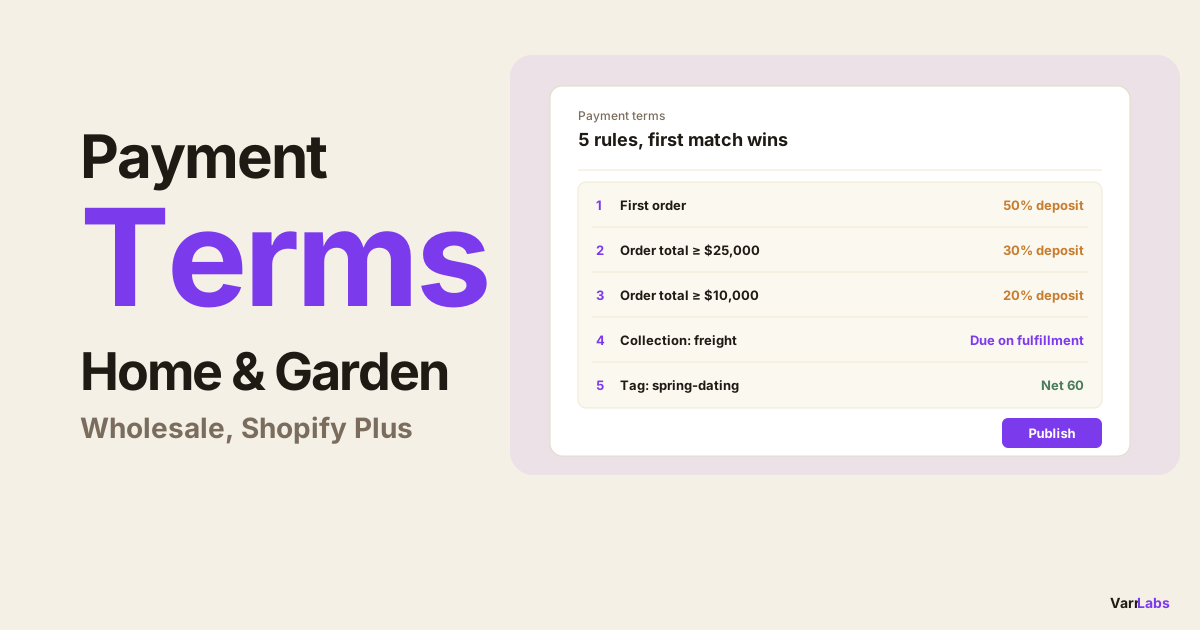
Here's a starting rule stack. Rules evaluate top down and the first match wins, so order matters.
- First order, require full prepayment. A brand-new account pays in full before anything ships, whatever's in the cart. This is your new-account protection.
- Cart contains custom or made-to-order products, require a 50% deposit. Keyed to a collection, so any cart with custom goods collects half upfront to cover committed production. Below the first-order rule, so a new account's first custom order still prepays in full.
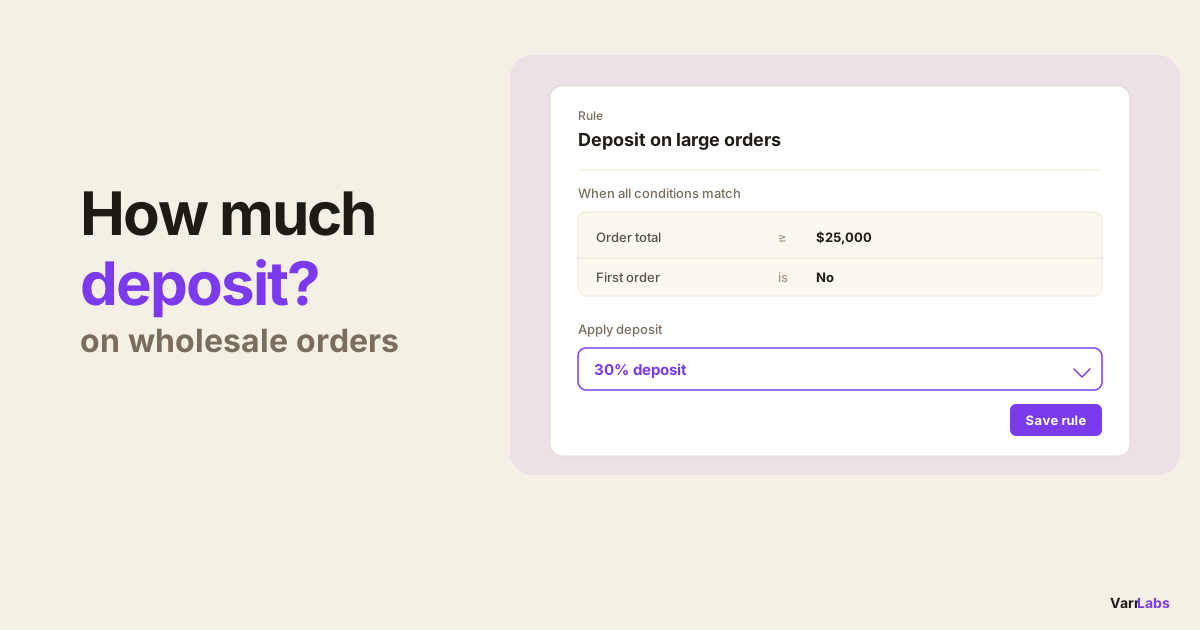
- Order total at or above $25,000, require a 30% deposit. Large stock orders from established accounts pull cash forward without blocking the sale.
- Everything else, no deposit. Small reorders from proven accounts ship clean on their existing terms.
A first-time buyer hits rule one and prepays. An established account ordering custom goods hits rule two and puts down 50%. That same account placing a large stock order hits rule three at 30%, and a small reorder falls through to rule four with nothing down. One policy, four orders, four different deposits, all decided automatically.
In TermStack you build this as an ordered list of rules in a UI, no Function code, and each rule can pair a deposit with a payment term. Both percentage and fixed-amount deposits work as outcomes, and the deposit is set independently of the term, so you can pair a 30% deposit with Net 30 on the balance. The dynamic deposits post walks through the mechanics, and the conditional deposits guide covers the setup in more detail.
TermStack reads order total, first order, order history, and cart contents at checkout and applies the deposit you set for that case, with a simulator to test each rule and one-click rollback if it's wrong. Try TermStack free for 14 days →
A quick sizing checklist
Before you set a deposit on the next wholesale order, run it against three questions:
- Do I know this buyer? No history means collect more upfront. A solid history means you can ease off.
- What do I lose if it falls through? Bigger exposure means a bigger deposit. Scale it to the number, not a flat rate.
- Can I resell the goods? Stock is low risk. Custom is a potential total loss, so cover your committed cost.
If you can answer those, you have your deposit. The hard part isn't deciding the number, it's making Shopify apply the right one per order instead of the same one to everybody.
Frequently asked questions
Summary
A wholesale deposit is a price you put on risk. New accounts, large orders, and custom goods each push it up; a proven buyer placing a small reorder pushes it to zero. The common landing spots are 20-30% on large stock orders, 50% on first orders, and 30-50% on made-to-order, with full prepayment reserved for the cases you genuinely can't price any other way.
The catch is enforcement. Shopify Plus gives you one static deposit per company location, which can't tell a first order from a reorder or a $500 cart from a $50,000 one. Making the deposit match the risk means deciding it at checkout, per order, from conditions you set.
- Try the live demo store → to see deposit rules applying at a real B2B checkout.
- Want help setting up your first rules? I'll do it with you on a free 30-minute call: your deposit policy, live at checkout, before the call ends. Email termstack@varrlabs.com.
TermStack gives you the conditions, the simulator, and the version history to run that policy at Shopify's native checkout, so the deposit on every order reflects the risk instead of a number someone set on the company once and forgot.