Payment Terms for Beauty and Cosmetics Wholesalers on Shopify
How beauty wholesale payment terms work on Shopify Plus: Net 15 by default, Net 30 earned by order count, and prepay on first and short-dated orders.
Key Takeaways
- 1Beauty and cosmetics wholesale runs on small, frequent reorders, so terms should be short by default and earned by order history.
- 2Net 15 fits a two to three week reorder rhythm. Net 30 is the term an account earns, not the one it starts on.
- 3A starting recipe: payment at checkout on first orders and short-dated stock, Net 30 after six previous orders, Net 15 after one.
- 4Payment terms only apply to company buyers, so retail shoppers on the same store see their normal checkout.
- 5TermStack applies these rules per order at Shopify's native B2B checkout, with a simulator to test them first.
Beauty wholesale payment terms come down to one fact about the vertical: your accounts reorder small and often. A salon doesn't buy a season of stock. It buys a few weeks of it, sells through, and comes back.
That changes the question. With a salon or boutique placing its tenth $400 order of the year, a long term isn't the risk. The risk is the pile of small open invoices nobody is watching, and the new account that got Net 30 on day one because that's what the company record said.
This post covers the term structures that fit beauty and cosmetics wholesale, a four-rule recipe with real numbers, and what Shopify does natively versus what needs a rule at checkout.
What makes beauty wholesale payment terms different
Most payment terms advice is written for big, infrequent orders. Beauty and cosmetics wholesale runs the other way on four counts.
Small, frequent reorders. Salons, spas, and independent boutiques top up instead of stocking deep. Each invoice is small, and there are a lot of them. A term that takes any effort to manage per order costs more than the order is worth.
High-velocity SKUs. A short list of products tends to do most of the volume: the hero serum, the best-selling shade, the backbar basics. Buyers reorder the same lines again and again, so the account's history tells you far more than any single cart does.
Retail, marketplace, and wholesale on one store. A lot of beauty brands sell direct to consumer and wholesale from one store. The same catalog and the same inventory serve a retail shopper, a marketplace order, and a salon account. Whatever you do for terms has to leave the retail checkout alone.
Expiry pressure. Skincare, SPF, and anything else with a date on it loses value while it sits. When a batch gets close to its date you discount it to move it. That's stock you want paid for now, not turned into another receivable.
Put those together and the policy writes itself. Terms should be short by default, earned by order history, and strict on the two orders that carry the most risk: the first one, and the short-dated one.
The term structures that fit cosmetics net terms
Four structures cover most of what beauty and cosmetics wholesalers need.
| Structure | What it means | Where it fits |
|---|---|---|
| Pay at checkout | Full payment with the order, no terms | First orders and short-dated stock |
| Net 15 | Full payment 15 days after invoice | The default for accounts that reorder often |
| Net 30 | Full payment 30 days after invoice | Accounts with an order history behind them |
| Order-count graduation | The term improves as previous orders add up | Moving accounts from prepay to Net 15 to Net 30 |
Net 15 is the one that fits the reorder rhythm. If an account comes back every two or three weeks, a 15-day term means the last invoice is due around the time the next order lands. On Net 30 that same account usually has two invoices open at once.
Net 30 still has a place. It suits a larger stockist, and it's a fair reward for an account that has ordered from you for months. The point is that it gets earned.
The four-rule recipe, with numbers
Here's a starting recipe. Adjust the thresholds to your own reorder cadence, but keep the order, because rules evaluate top down and the first match wins.
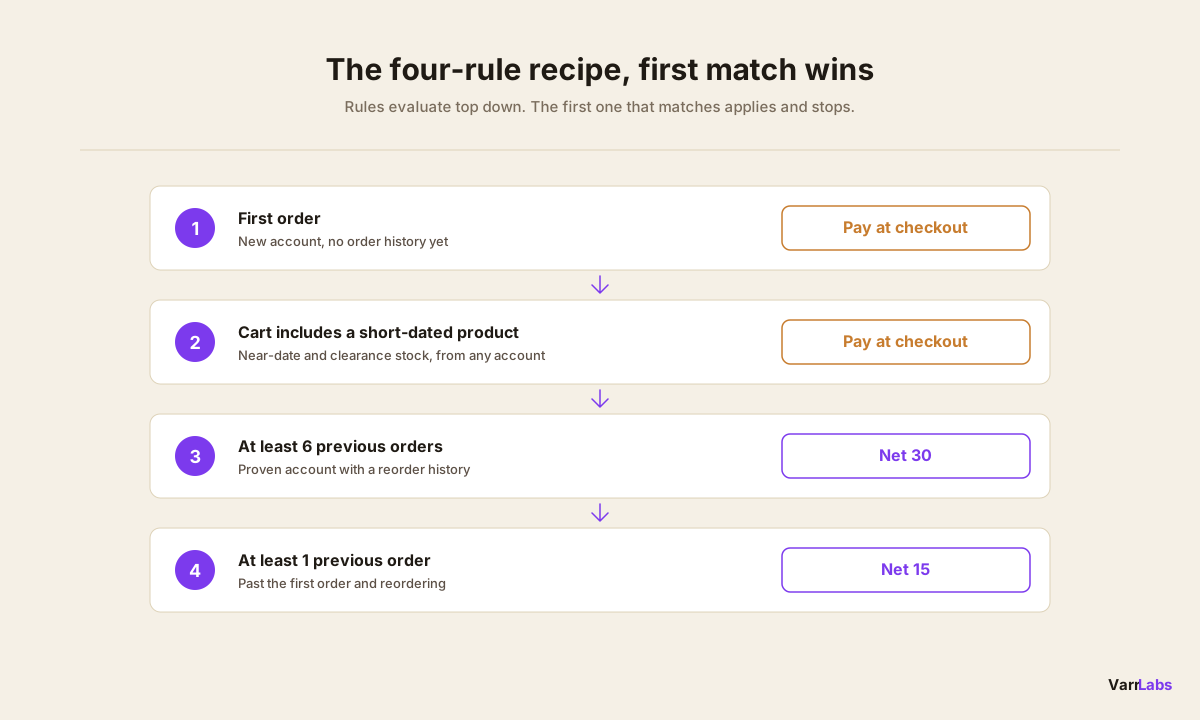
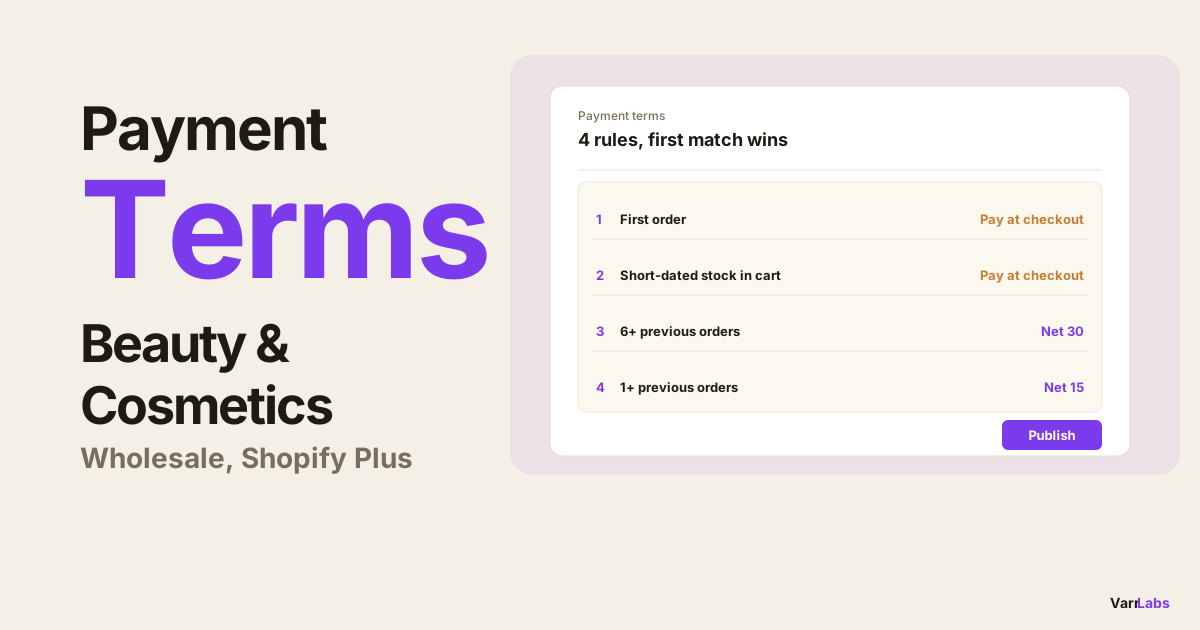
- First order, payment at checkout. A new account pays in full on its first order, whatever the size. Beauty first orders are small, so this is a low-friction ask, and it covers you on the one order where you know nothing about the buyer. The first-time buyer prepayment post covers the reasoning.
- Cart includes a product from your short-dated collection, payment at checkout. Put near-date and clearance stock in one collection. Any order that contains one of those products is paid up front, even from your best account.
- At least 6 previous orders, Net 30. A buyer who has come back six times has shown you how they buy. It sits above the Net 15 rule so a proven account matches the better term first.
- At least 1 previous order, Net 15. Everyone past their first order gets a short net term without anyone editing the account.
Run a few orders through it. A new salon places a $600 opening order, hits rule one, and pays $600 at checkout. Three weeks later it reorders $450. It now has one previous order, so it lands on rule four and gets Net 15. On its seventh order it has six previous orders, matches rule three, and gets Net 30.
Now take that same Net 30 salon adding a case of short-dated SPF from the clearance collection to a $520 reorder. Rule two matches first and the whole order is paid at checkout.
Two details are worth knowing before you set the thresholds. The order count is the number of previous orders, so the order being placed doesn't count toward it. And a term applies to the whole order, not to a line, so one clearance item in a cart moves the entire cart to pay at checkout. If that's too blunt for you, sell short-dated stock as its own order. The order-count graduation post goes deeper on where to put the rungs.
Running retail and wholesale on the same store
This is the part beauty brands worry about most, and it's the part Shopify handles well.
Shopify keeps the two buyer types apart at checkout. A wholesale buyer logs in under a company. A retail shopper doesn't have one. Payment terms only exist on the company side, so a retail customer never sees Net 15 as an option and can't pick it by accident.
Rules at checkout follow the same line. They only evaluate when a company is buying. An order with no company on it goes through your normal retail checkout untouched, with the payment methods you already offer.
That means you can run a strict wholesale policy without touching the retail experience. The guide to running B2C and B2B on the same store walks through the full setup.
How you'd do this natively, and where it breaks
Shopify lets you assign a payment term per company location. Go to Customers → Companies → [Company] → Location, pick a template such as Net 15 or Net 30, and save.
That's a static assignment. It applies to every order from that location until a person changes it. For beauty wholesale it breaks in three places:
- First orders. Nothing checks whether it's the buyer's first order. A new account gets whatever was set when the company was created.
- Graduation. Nothing counts a buyer's orders. Moving an account from prepay to Net 15 to Net 30 means editing each location by hand and remembering who has earned what. With a long list of small accounts, that job never gets done.
- Short-dated stock. The stored term doesn't know what's in the cart. A full-price reorder and a clearance order get the same term.
The native versus app comparison walks through the full boundary.
Common mistakes to avoid
Putting Net 15 above Net 30. First match wins. An account with eight previous orders also has at least one, so if the Net 15 rule sits on top, the Net 30 rule never fires.
Putting the graduation rules above the short-dated rule. If Net 30 is checked first, your best accounts buy clearance stock on 30-day terms. The two pay-at-checkout rules go on top.
Treating order count as a credit check. The count tells you how many orders an account has placed. It doesn't tell you whether the invoices were paid on time. Keep a tag for accounts you want held on prepay, and put a rule for that tag at the top.
Testing on a live order. These rules touch every wholesale checkout on the store. Run each scenario through a simulator first. The guide to testing payment rules before go-live walks through it.
When native Shopify isn't enough
Everything in the recipe depends on reading the order at checkout: whether it's the first one, how many came before it, what's in the cart. Native terms have no evaluation step, so there's nothing to attach a condition to.
TermStack checks first order, order history, collections, and tags at checkout, then applies the right term automatically. Try TermStack free for 14 days →
TermStack is the app I built for this. It runs your rules at Shopify's native B2B checkout through a Payment Customization Function, with no external call during checkout. Each rule combines conditions with an outcome, and an outcome is a payment term plus an optional deposit. You test every scenario in the simulator before you publish, and you can roll back to a previous version if a rule turns out wrong.
Quick reference
| Rule (in order) | Condition | Applied term |
|---|---|---|
| 1 | First order | Payment at checkout |
| 2 | Cart includes a short-dated collection product | Payment at checkout |
| 3 | At least 6 previous orders | Net 30 |
| 4 | At least 1 previous order | Net 15 |
Frequently asked questions
Summary
Beauty and cosmetics wholesale is a business of small, frequent reorders on a short list of fast-moving products, often on the same store as retail. The terms that fit are short by default and earned over time.
Four rules cover most of it: payment at checkout on first orders, payment at checkout on anything from your short-dated collection, Net 30 once an account has six previous orders, and Net 15 for everyone else past their first. Keep the two pay-at-checkout rules on top and Net 30 above Net 15.
- Try the live demo store → to see payment terms rules applying at a real B2B checkout.
- Want help setting up your first rules? I'll do it with you on a free 30-minute call: your graduation rules, tested in the simulator and live at checkout before the call ends. Email termstack@varrlabs.com.
TermStack gives you the conditions, the simulator, and the version history to run that policy at Shopify's native checkout, so every new account starts on prepay and every regular account moves up without anyone editing a company record.